
ERNESTO GONZALEZ
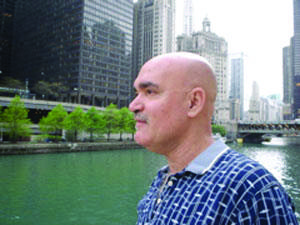
Ernesto González, a Cuban writer, holds a degree in Scientific Information and is the author of several novels.
He has published poems, short stories, and articles in digital and Chicago media outlets.
He served as an advisor for the Spanish Proficiency Test created by Riverside Publishing.
He worked as a Spanish professor at East-West University and the Cultural Exchange language academy, and for thirteen years as a translator for the Chicago Tribune’s Hoy newspaper.
His novels are available on Amazon.
EPICURUS THE BUDDHA
A woman’s laughter and a man’s mockery slow down his dance.
But they don’t stop it. He joins in their laughter.
With a gesture, he invites them to dance.
An attempt that often fails and he repeats with hope.
He goes back to his thing, which is dancing. Let others speak.
Especially those who observe to be shocked and disapproved.
There is nothing good for those paralyzed by the tongue and its judgments.
At some point they will see that they are talking to no one and will remain silent.
He continues dancing, which is his thing.
He moves without expectations.
He doesn’t plan or do too many calculations. He lacks nothing.
He urges no one or gives instructions.
One can only do what one is, he seems to tell us.
Incapable of hating, he heals his wounds and that’s it.
He doesn’t blame the truces of the exhausted.
Nor the obstacles of the half-living, incapable of burning.
They lack half of the dance.
In the direction of the figure, the stones fly. The usual.
They are leftovers of indigestible food that do not even touch it.
Stupidity always awaits a response. If there is not one, it is its defeat.
There is no rebound because there was no blow.
These stones join the dance, they exalt it.
There is no stoned dancer, but only dance.
He pays attention to us for the seconds that last his failed invitation.
He is not going to waste time with children who refuse to grow.
The blind man will cure his blindness!, the dance shouts, and he smiles as he moves.
He cannot love like us. He does not understand what we are referring to.
Ours why and ours when. There is no manual or instructor beyond himself.
He savors the sweet, swallows the bitter.
Without complaints or spills, he is a transmuter.
If it is a matter of preferences, and if he loves something,
it is the middle ground that moves him.
He dives into the recesses of those foreign bodies, where he always drowns.
His drowned face shines, returning from the depths.
Like Poseidon, he generates earthquakes, he tames horses.
He loves until the last drop, if that is what it is about.
Loving, he disappears, as when he dances.
He does not say it. It would be unnecessary, confusing.
He drags it with him, he enjoys it and that is enough.
Why mention the volatile, if the dance of life is at hand?
One could swear: he is not one of us.
He is not circumscribed to himself, reduced and apocryphal.
He does not expect anything, nor calculate. He does not compare.
Nor does he jump from one desire to another unbridledly.
What he seeks or has already found is not there.
His dance, his songs, his cries like sparks that ignite, are neither visible nor heard.
The stones they throw at him are not necessarily rocky.
He is not there even if we see him, it is a form he uses. One more, among many.
He walks naked or elegant. He complies with what has been imposed on him.
Without wearing himself out.
He saves strength to continue dancing. To drown in anybody
and love until he dries up. And then continue shining.
We will never discover it, unfortunately.
We lack depth in our gaze. Inner lights, trackers.
Meanwhile, he passes us by in the opposite direction,
dancing endlessly.
Ernesto González © 2025
